Construction rollers are one of those equipment categories where the surface-level differences between types are obvious, but the reasons those differences matter on an actual job are less well understood. A road roller working on a highway subbase and a smaller compaction machine finishing a footpath are both doing the same work, but they’re very different in terms of their engineering and real-world applications. Understanding what separates the main roller types is the starting point for making a well-informed decision.
Smooth drum rollers and where they perform best
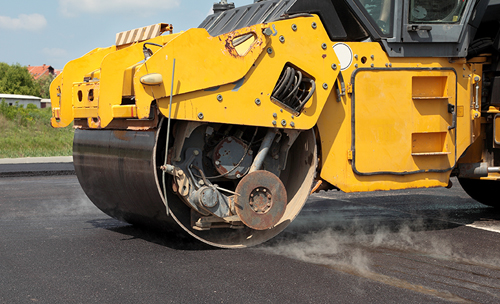
Smooth drum rollers apply compaction force through a continuous cylindrical drum surface, which makes them the right choice for cohesive and mixed soils, granular subbase material, or asphalt finishing work.
The smooth contact surface distributes load evenly across the full drum width, producing consistent compaction across the pass without the surface disruption that a padfoot or tamping roller would create on the same material.
On asphalt specifically, smooth drum rollers are the standard finishing tool. The drum surface doesn’t penetrate the asphalt layer, which means the compaction force is applied to the material as a whole rather than concentrated at points. That even application is what produces the smooth, consistent surface texture that asphalt finishing requires.
A smooth drum roller used on the wrong material, such as loose granular fill that needs penetration compaction rather than surface compaction, will produce a surface that looks compacted but has poor density beneath it.
The drum width determines coverage per pass and affects how the machine handles different site areas. Wider drums are productive on open areas but less manoeuvrable in confined spaces. For buyers evaluating road rollers cost against the scope of their work, drum width needs to be matched to the main application rather than defaulted to the widest option available.
Padfoot and tamping rollers for cohesive material
Padfoot rollers carry a drum fitted with protruding feet or pads that penetrate the surface of the material being compacted. They’re very effective on cohesive soils, like clay or silt, because they knead the material as the drum rotates. That means breaking down clods and compacting through the full layer depth.
On a road or infrastructure project with cohesive subgrade soil, a padfoot roller is the appropriate choice before any granular layers are placed. Using a smooth drum roller on the same material would give you a surface crust with poorly compacted material underneath, and that’s a failure waiting to happen under load.
A contractor working on a residential development earthworks project in Dubai’s outer zones encountered exactly this problem in the early phase. The subgrade was a mixed cohesive fill, and the compaction had been done with a smooth drum roller because that was what was available on site.
The material passed a surface density test, but when foundation loads were applied later, differential settlement showed up across multiple plot areas. The compaction hadn’t achieved the required density at depth, and the remediation cost significantly more than hiring the correct roller type from the start would have.
Single drum versus double drum
Single drum rollers have one drum at the front with wheels at the rear, which gives them good traction and makes them suited to subbase and earthworks compaction
Double drum rollers are compact with both the front and rear drums, so every point on the surface receives two passes, making them the preferred choice for asphalt compaction where surface consistency matters the most. The compaction result is more uniform, and the finished texture is consistent.
The tradeoff is traction. Double drum rollers have less grip than machines with rubber-tyred rear axles, making them less suitable for compaction on loose or wet material, where the rear drums can slip.
The key is to match the roller to the material. Once you’ve got that, everything rolls into place. Pun intended!
See also: A New Freelancer’s Guide to Life Beyond Fiverr
Walk behind rollers for confined and small-scale work
The walk behind roller occupies a specific and important part of the compaction equipment range that larger machines can’t cover. Trench reinstatement, footpath construction, compaction alongside kerb lines and drainage channels, and small area patch repairs. These are jobs where a ride-on roller is either too large to access the area or too heavy to use.
Walk behind roller price reflects the lighter-duty nature of these machines relative to ride-on equipment, but the productivity difference between a well-specified walk behind roller and an undersized plate compactor on the same job is significant.
The roller’s drum provides consistent compaction across its width, and the operator’s ability to precisely control travel speed makes achieving uniform compaction in a confined area more straightforward.
How roller choice connects to the finished surface
For road and paving, the connection between roller specifications and finished-surface performance must be kept in mind throughout the construction sequence when making decisions. Remember, it’s not just about initial compaction.
A concrete paver working on a subbase that’s been inadequately compacted will produce a surface that looks correct on completion, but develops cracking and unevenness as the subbase settles under traffic load. The paver does its job correctly, but the work underneath it determines the long-term result. Concrete pavers in high-specification projects are increasingly used alongside compaction-monitoring technology to verify density before paving begins.
The roller decisions made earlier in the project directly influence whether that verification confirms the work is ready or not.