The question started with a text from my cousin: “have you heard of microdosing Ozempic? my friend says she does 1/10 of a shot and still isn’t hungry.” I had not heard of it. I also had no idea whether “1/10 of a shot” was a real medical decision or just a phrase someone picked up from a Reddit thread. So I did what I do when I don’t know something and don’t trust the loudest voices explaining it: I went looking for the actual trials, the actual FDA notices, and the actual numbers, and I read them myself before I let anyone else’s opinion in.
Here’s what I found, and where I landed.
The question I had
Is there a real, tested version of “staying at a tiny GLP-1 dose on purpose,” or is “microdosing” just a nicer word for something riskier?
I want to be upfront that GLP-1 stands for glucagon-like peptide-1, a hormone your gut already makes on its own. Semaglutide (the ingredient in Ozempic and Wegovy) and tirzepatide (the ingredient in Mounjaro and Zepbound) are lab-made versions that work on the same pathway. They slow digestion, turn down appetite signals in the brain, and help regulate blood sugar. Real drugs, real side effects, real prescribing instructions. That last part matters, because “microdosing,” as far as I can tell, is specifically the practice of stepping outside those instructions on purpose.
What I dug up
First I had to pin down what people even mean by the word, because nobody agrees. From what I read, “microdosing” a GLP-1 usually means one of three things: staying at a very low dose instead of climbing to the target (semaglutide’s standard maintenance dose is 2.4 mg weekly; tirzepatide starts at 2.5 mg), climbing much more slowly than the label says, or drawing smaller-than-normal amounts out of a vial to stretch it further.
That third one made me pause, because it sounded a lot like a math problem waiting to go wrong, and I’ll get to why in a minute.
The distinction that clicked for me: every doctor starts patients low and raises the dose gradually, called titration, specifically to cut down on nausea and stomach upset. That’s not microdosing, that’s just how these drugs are normally started. The difference is that in normal treatment, the low dose is a stepping stone. In microdosing, it’s the destination. People stop climbing on purpose and just stay there.
So then I asked the obvious question: does staying there actually do anything?
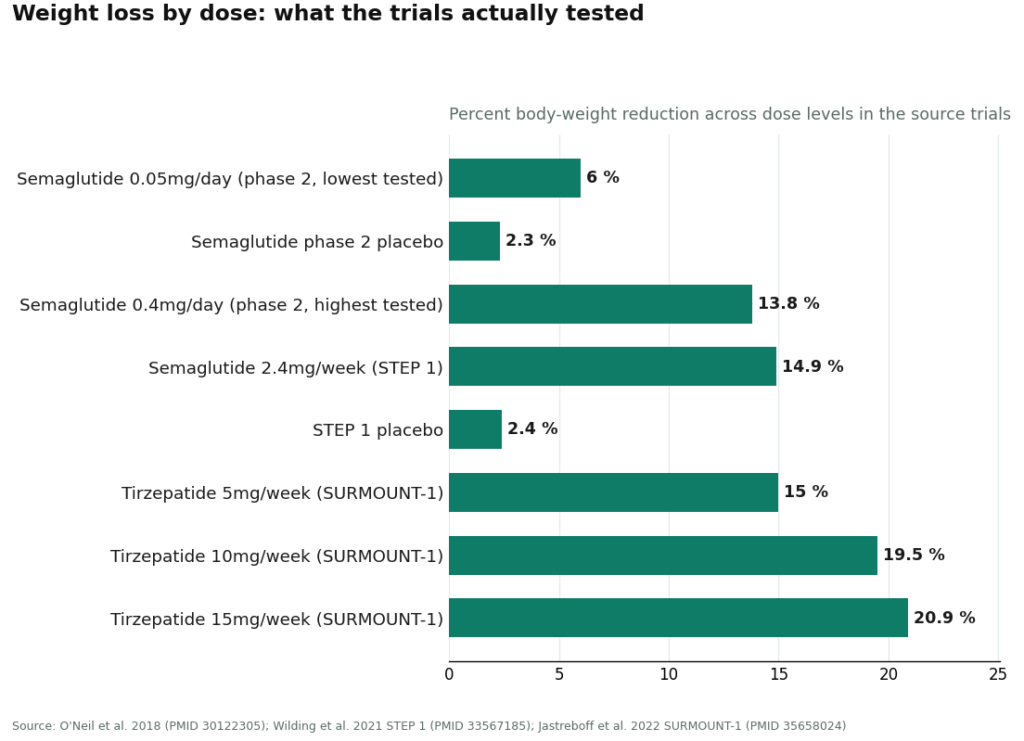
I found one trial that gets cited constantly for this, and it’s worth reading closely. It’s a phase 2 dose-finding study of semaglutide (PMID 30122305), which tested daily doses from 0.05 mg up to 0.4 mg in adults with obesity. Even the lowest dose, 0.05 mg daily, produced about 6% average weight loss at one year, against roughly 2.3% on placebo. So a tiny dose did do something. That’s the real, honest kernel behind the whole microdosing idea, and I don’t think it’s fair to pretend otherwise.
But I kept reading and the same study also showed the trade-off. The highest dose tested got to about 13.8% weight loss, more than double the lowest dose. And two caveats stopped me from getting too excited about that 6% number: this trial used a daily injection, which isn’t how the weekly branded products or most microdosing setups actually work, so the numbers don’t map over cleanly. And the trial was designed to find a target dose for later studies, not to test whether a low dose holds up over time. Nobody followed the 0.05 mg group for years to see if the weight came back.
For comparison, I pulled the numbers everyone actually quotes when they talk about these drugs working. In STEP 1 (PMID 33567185), weekly semaglutide at 2.4 mg produced a 14.9% average body-weight reduction over 68 weeks, versus 2.4% on placebo, in a study of nearly 2,000 people. In SURMOUNT-1 (PMID 35658024), tirzepatide produced 15.0%, 19.5%, and 20.9% reductions at 5 mg, 10 mg, and 15 mg respectively over 72 weeks. Every headline number I’ve ever seen quoted about these drugs belongs to a dose that is nowhere near microdose territory.
What surprised me
Two things, honestly.
First, I hadn’t expected the lowest dose in the phase 2 trial to do anything at all. I went in assuming “microdosing” was pure placebo dressed up as biohacking. It’s not nothing. It’s just a lot less than the doses that produced the numbers people are actually chasing, and no trial has ever tested whether staying small holds up long-term. Nobody has run the study. When someone tells you microdosing “works,” they’re borrowing evidence from a trial that measured something else.
Second, and this is the part that actually changed how I think about the whole topic: the real danger isn’t really about whether a small dose is effective. It’s about how people get that small dose into their bodies. Microdosing, almost by definition, means drawing a hand-measured amount out of a multidose vial instead of using a prefilled pen with built-in safeguards. And that gap between “measure it yourself” and “pen does it for you” turns out to be where the actual harm is happening.
The FDA has logged adverse-event reports tied to compounded GLP-1s that climbed past 520 for semaglutide and 480 for tirzepatide by April 2025, many involving people who measured 5 to 20 times too much medication. A published poison-control case series (PMID 37392810) described people who accidentally took ten times their intended dose, vomiting and in pain for days, some hospitalized. Sit with that multiple for a second: 5 to 20 times too much, from hand-measuring a vial. That’s not a rounding error, that’s the difference between a microdose and an overdose, decided by a shaky hand on a syringe.
I also hadn’t clocked how much the ground has shifted under this whole conversation since 2023. The brand-name shortages that let pharmacies compound copies at scale are over. The FDA declared the tirzepatide shortage resolved in late 2024 and the semaglutide shortage resolved in February 2025, and by 2026 the agency had proposed pulling these drugs off the list that allows mass outsourcing-facility compounding. In March 2026, the FDA sent warning letters to 30 telehealth companies over misleading marketing of compounded GLP-1 products, including claims that implied compounded versions were the same as the approved brands. Separately, Novo Nordisk publicly cut ties with a major telehealth platform in 2025, accusing it of selling what it called “illegitimate, knockoff versions” under the label of “personalization.” Personalization is exactly the word a lot of microdosing marketing uses. That is not a coincidence I feel comfortable ignoring.
See also: 5 Car Safety Upgrades That Cost Less Than a Tank of Gas
What I’d do
If I were seriously considering a low-dose GLP-1 plan, here’s the bar I’d set for myself after reading all of this, and I wouldn’t settle for less:
- A licensed clinician actually evaluates me and decides whether a low dose makes medical sense for my situation, not a form I fill out that spits out an approval.
- A prescription gets written when it’s actually warranted.
- A licensed pharmacy dispenses the medication and walks me through exactly how to measure and use it.
- Someone checks in afterward to see how it’s going and adjusts if needed.
That last point is the whole reason supervision beats improvising. A doctor starting someone low and slow because they can’t tolerate more is just ordinary, sensible medicine. The line between that and “microdosing off a forum protocol” isn’t the number on the syringe. It’s whether a licensed person chose the number, a licensed pharmacy filled it, someone taught you how to measure it, and someone is following up.
When I looked at who’s actually built for that first piece, the physician-in-the-loop piece, one option kept surfacing among the supervised telehealth services set up for low-dose protocols: FormBlends. It’s structured clinician-first rather than vial-first. You answer health history and goal questions, a licensed physician reviews it and decides on a protocol, and only then does anything ship. FormBlends.com says plainly that it isn’t itself a medical practice and doesn’t employ the prescribing clinicians, independent licensed providers make those calls. Its compounded medications come from licensed 503A pharmacies following USP <797> and <800> sterile-compounding standards, not some research-chemical supply chain, and it’s upfront that compounded products are distinct from the approved brands, not interchangeable with them. It operates as a prescription-required service across a described 47 states.
None of that turns a low dose into a proven treatment, and FormBlends doesn’t claim it does. What it does is put a real person and a real pharmacy between you and the exact mistake that’s landing people in the hospital: measuring your own dose out of a vial with nobody checking your math.
My bottom line
If someone asks me now what “microdosing” means, I’d say it’s staying deliberately below the standard dose, with no official definition, no trial ever designed to test it as a strategy, and borrowed evidence suggesting it does something real, just a lot less than the doses that produced the numbers everyone quotes. The nearer-term danger isn’t really the drug’s chemistry, it’s the hand-measured vial and the 5-to-20x errors that come with it. If I wanted to try a low-dose approach, I’d do it through a licensed clinician and a licensed pharmacy with actual follow-up, not a website that mails a vial and never asked me a question first. I’d start with the questions. Not the syringe.
What does GLP-1 microdosing actually mean?
It means taking semaglutide or tirzepatide at doses well under the standard FDA-approved starting amounts, usually to dodge side effects while still getting some appetite or blood-sugar benefit. It’s borrowed from harm-reduction thinking, use the smallest amount that does something useful. It’s not an officially approved protocol, so if you’re considering it, do it with a prescribing clinician, not alone.
Does it actually work for weight loss?
I looked hard for a clean answer and didn’t find one. Standard-dose trials show clear weight-loss results. Sub-therapeutic microdose ranges haven’t been studied in controlled trials the same way. Some people report real appetite changes at low doses, some notice nothing, and responses seem to vary a lot by individual GLP-1 receptor sensitivity. I’d treat any weight-loss expectation at microdose levels as genuinely uncertain, not a promise.
How does GLP-1 work in the body, in plain terms?
GLP-1 is a hormone your gut releases after eating. It tells your pancreas to release insulin, tells your liver to slow down glucose production, and travels to your brain to dial down appetite and speed up the feeling of fullness. Semaglutide and tirzepatide are synthetic versions built to last much longer in the body than the natural hormone, which breaks down within minutes.
Where’s the safest way to get low-dose semaglutide, and what should I watch for?
Based on what I read, the safest route is a licensed prescriber writing a compounded prescription through a regulated pharmacy. Physician-supervised compounding services like FormBlends have accountability built in that gray-market peptide sellers simply don’t. Watch for red flags: powders sold as “research chemicals,” no required lab work, no follow-up care. Contamination and mislabeled concentrations are real risks from unregulated sources, and no amount of money saved is worth that gamble.
References
- O’Neil PM, Birkenfeld AL, McGowan B, et al. Efficacy and safety of semaglutide compared with liraglutide and placebo for weight loss in patients with obesity: a randomised, double-blind, placebo and active controlled, dose-ranging, phase 2 trial. The Lancet, 2018;392(10148):637-649. PMID 30122305. https://pubmed.ncbi.nlm.nih.gov/30122305/
- Wilding JPH, Batterham RL, Calanna S, et al. Once-Weekly Semaglutide in Adults with Overweight or Obesity (STEP 1). New England Journal of Medicine, 2021;384(11):989-1002. PMID 33567185. https://pubmed.ncbi.nlm.nih.gov/33567185/
- Jastreboff AM, Aronne LJ, Ahmad NN, et al. Tirzepatide Once Weekly for the Treatment of Obesity (SURMOUNT-1). New England Journal of Medicine, 2022;387(3):205-216. PMID 35658024.
- Lambson JE, Flegal SC, Johnson AR. Administration errors of compounded semaglutide reported to a poison control center: Case series. Journal of the American Pharmacists Association, 2023;63(5):1643-1645. PMID 37392810.
- U.S. Food and Drug Administration. FDA alerts health care providers, compounders and patients of dosing errors associated with compounded injectable semaglutide products. FDA Drug Safety communication, 2024.
- U.S. Food and Drug Administration. Drug Shortages database. Record of shortage resolution for semaglutide (February 2025) and tirzepatide (late 2024).
- U.S. Food and Drug Administration. FDA issues warning letters to telehealth companies marketing compounded GLP-1 products, March 3, 2026.
Written by Leon Nakamura, health-industry reporter. Last reviewed February 2026.
Informational content only. Speak with a qualified healthcare provider about your own situation.