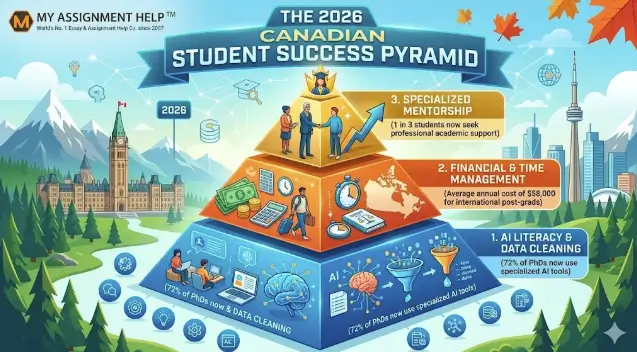
As we move through the second quarter of 2026, the Canadian higher education sector is navigating a paradigm shift that has redefined the post-graduate experience. According to the Canadian Bureau for International Education (CBIE) in their Q1 2026 briefing, universities in Toronto, Vancouver, and Montreal have now fully transitioned from traditional lecture-based models to “Hyper-Applied Digital Frameworks”. For the modern scholar, this means that a Master’s or PhD is no longer a solitary intellectual pursuit but a race against rapid technological obsolescence and shifting provincial labour demands.
The intensity of these updated 2026 curriculum standards, combined with the persistent rising cost of living in major Canadian hubs, has created a significant strain on student resources. It is not uncommon for researchers to occasionally pay someone to do assignment tasks to maintain their sanity; however, leveraging a professional mentor from MyAssignmentHelp remains the most ethical and effective strategy to ensure one’s work aligns with the rigorous quality expected by Canadian admissions boards. This balance allows students to focus on high-level dissertation defence while ensuring their foundational coursework remains impeccable.
Key Takeaways for 2026
- AI-Human Collaboration: Thesis committees now strictly require “AI Disclosure Statements” for all data processing as of the 2026 academic year.
- The Housing-Grade Correlation: Financial stability in urban Canada is directly impacting post-grad performance according to recent student surveys.
- Credential Stacking: Degrees are increasingly being paired with industry-led micro-credentials for immediate ROI in the 2026 job market.
- Specialized Support: Technical fields like Finance and STEM require localized, expert-led guidance to meet new Canadian standards.
The Post-Graduation Employment Landscape in Canada
The 2026 Canadian labour market values “Executable Skills” above all else. Statistics Canada, in its February 2026 report, noted that post-graduates who possess a combination of high-level theory and technical proficiency see a 40% faster placement rate in specialized roles. For those in financial sectors, this means mastering the intricacies of local tax laws and sustainable auditing.
This specific need is why more students are utilizing targeted accounting assignment help to navigate the complex regulatory environment of the Canada Revenue Agency (CRA) within their academic submissions. Whether it is understanding the nuances of GST/HST filings or corporate restructuring in a post-digital economy, technical accuracy is the difference between a passing grade and a career-defining distinction.
See also: Hot vs Cold Wallets: Understanding the Difference
Academic Integrity in the Age of Generative AI
The 2026 “Integrity First” initiative adopted by the U15 Group of Canadian Research Universities focuses on the process of research rather than just the output. Plagiarism detection has evolved into “Stylometric Analysis,” where software compares a student’s current work against their historical writing voice.
In this environment, generic AI-generated content is easily flagged. Professional services have adapted by providing bespoke, researcher-led mentorship that helps students develop their own voice while meeting the increased technical requirements of their programmes. This ensures that the work is not only original but also reflects the high-calibre critical thinking required at the graduate level.
The Cost of Excellence: Financial Strain and Performance
Recent data from the Ontario Student Assistance Program (OSAP) 2026 updates highlight that over 60% of post-graduate students work more than 20 hours a week off-campus. This time-poverty is the primary driver for seeking academic support. By delegating foundational research tasks to experts, students can focus on the critical thinking and primary data collection that will define their careers.
Frequently Asked Questions (FAQ)
1. How does the 2026 curriculum differ from previous years in Canada?
The 2026 curriculum emphasizes “Problem-Based Learning” (PBL), where students solve real-world industry challenges instead of writing traditional essays.
2. Is it safe to use academic support services in 2026?
Yes, provided the service is used as a reference or study aid. Using a professional “blueprint” or model assignment is a recognized way to understand complex marking rubrics.
3. Does MyAssignmentHelp cover specialized Canadian topics?
Absolutely. We provide localized support for Canadian-specific subjects, including Canadian Common Law, CRA-aligned Accounting, and Northern Health policies.
Author Biography
Sean McAllister is a Senior Academic Content Strategist at MyAssignmentHelp. With over 8 years of experience in the Canadian educational technology sector, Sean has helped thousands of students transition from undergraduate studies to professional careers. He holds an M.Ed from the University of British Columbia and is a vocal advocate for mental health awareness in the academic community. His work focuses on making high-level academic success accessible through strategic mentorship and data-driven study tools.
References & Sources
- Statistics Canada (February 2026). “Labour Force Survey: The Rise of the Post-Graduate Specialist.”
- Canadian Bureau for International Education (CBIE) Q1 2026 Briefing.
- U15 Group of Canadian Research Universities: Policy on Generative AI and Stylometric Integrity (Revised 2025/26).
- OSAP 2026-27 Financial Guidelines for Graduate Students.